
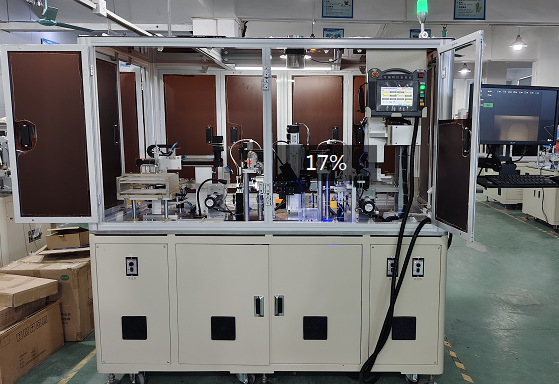
Industry Pain Point: The “Invisible Internal Hazard”
During the production of chip inductors, hidden cracks (also known as dark cracks) are an extremely concealed defect. They exist inside the magnetic core or coil substrate, where visible light cannot penetrate – conventional optical inspection equipment simply cannot see them. Traditional passive infrared thermal imaging relies on the product’s own heat emission. At room temperature, an inductor has almost no temperature difference, and crack areas do not generate heat on their own.
Once these “invisible” cracks reach the market, the consequences can be severe. Especially in high-reliability applications such as automotive power supplies, fast-charging modules, and communication base stations, soldering heat or mechanical stress can cause crack propagation, ultimately leading to inductance drift, short circuits, or even complete system burnout. Inductor manufacturers urgently need an inspection solution that can actively excite internal defects, produce clear images, and adapt to high-speed production lines. Donghong Precision’s new product is designed precisely for this purpose.
Donghong Solution: Active UV Excitation Makes Cracks “Heat Up and Show Themselves”
Based on years of technical expertise in automated chip inductor equipment, Donghong Precision Industrial Co., Ltd. officially launches its self-developed “Donghong UV-IR Thermal Imaging Crack Detector” to the global market. This device no longer relies on external light reflection or passive heat emission. Instead, it uses active UV excitation combined with real-time infrared thermal imaging.
The core principle is the photothermal conversion effect: when high-power UV light uniformly irradiates the surface and near-surface layer of the inductor, heat diffuses evenly in intact, dense material areas. At a hidden crack, the crack interface creates thermal resistance, causing localized heat accumulation. This physical effect makes the crack area significantly warmer than the surrounding intact material, producing a temperature difference that can be precisely captured by a high-sensitivity infrared thermal imager. In simple terms, the crack “heats itself up and reveals itself.”
Core Technology 1: Active UV Excitation – Precisely Generating Thermal Signals from Cracks
The first core technology of the Donghong crack detector is its high-power UV light source system. This system provides uniform, controllable UV irradiation to the chip inductor’s surface and near-surface layer, with energy density and exposure time adjustable for different inductor materials.
The UV energy is absorbed by the inductor substrate and rapidly converted into heat. In dense material areas, heat spreads uniformly, creating a smooth temperature field. At a crack interface, because the thermal conductivity of air inside the crack is much lower than that of the solid material, heat cannot transfer efficiently, causing the temperature at the crack edges to rise quickly. This temperature difference typically reaches its peak within tens of milliseconds, forming a clear “hot spot.” Compared to traditional ultrasonic or X-ray inspection, this method is more sensitive to micron-scale cracks and is completely non-contact, causing no damage to the product.
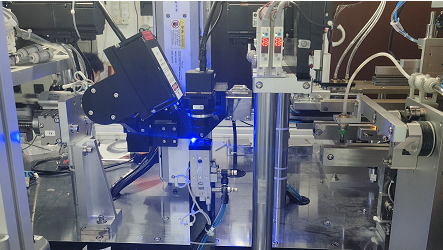
Core Technology 2: Infrared Thermal Imaging Camera – Capturing Micron-Level Temperature Differences in Milliseconds
With an actively generated temperature difference signal, a sufficiently sensitive “eye” is needed to capture it. The Donghong detector is equipped with a high-sensitivity infrared thermal imaging camera, offering three core capabilities.
First, high resolution: it can resolve minute temperature anomalies down to the pixel level, corresponding to actual crack widths as small as a few microns – even early-stage cracks just a few microns wide can be identified. Second, high-speed acquisition: it supports millisecond-level thermal signal capture, perfectly matching the high-speed rhythm of automated inductor production lines without becoming a bottleneck. Third, dynamic analysis: the device records the temperature field evolution curve after UV excitation in real time, comprehensively judging defect severity using peak temperature difference, heating rate, and decay characteristics – avoiding false positives from minor surface scratches.
Core Technology 3: Inductor-Specific Thermal Signature AI Recognition Model
UV excitation and infrared imaging solve the problem of “seeing” hidden cracks. But to achieve extremely low false-positive rates in high-volume full inspection, intelligent judgment is required. Based on thousands of real thermal imaging samples of cracked inductors, Donghong has trained a deep learning model dedicated to inductor defect recognition.
The model can accurately distinguish between different types of internal defects – such as molding cracks in the core, sintering cracks, and chamfering impact cracks – while effectively rejecting “false thermal signals” from surface contamination, electrode reflections, and material texture. In actual production line tests, the false-positive rate is controlled at an extremely low level. The model also supports rapid iteration: when a customer changes inductor models or materials, Donghong can quickly fine-tune the model with a small set of samples, without retraining the entire network.
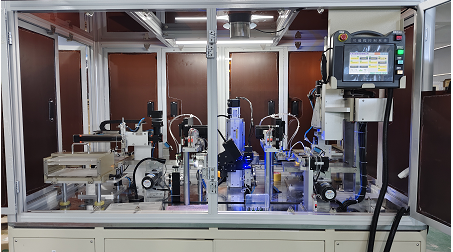
Seamless Integration into Donghong’s Automated Inductor Production Lines
As a company focused on inductor automation equipment, Donghong understands that “inspection must not slow down production.” The crack detector was designed from the start for seamless integration with existing lines. It can be placed directly between winding machines, dispensing machines, curing ovens, testers, and taping machines, supporting fully automatic loading and unloading, compatible with trays, vibratory bowls, and tape feeders.
In terms of cycle time, the total time from UV excitation to thermal imaging capture to AI judgment per inductor is ≤0.5 seconds, fully meeting the requirements of high-speed full inspection. The device also features real-time sorting, automatically separating good parts from those with hidden cracks, supporting defective counting, classification, and data traceability. It can communicate with upstream and downstream equipment to enable intelligent whole-line control. For customers already using other Donghong automation equipment, integration is even simpler.
Open to Global Markets: On-Site Testing with Your Own Samples – Seeing Is Believing
The Donghong UV-IR Thermal Imaging Crack Detector has entered mass production and is now open for on-site sample testing by inductor manufacturers and OEMs worldwide. Donghong welcomes customers to provide actual inductor samples – including known good parts and those with hidden cracks – for live validation at our facility. Customers can see for themselves: after UV excitation, how the crack “lights up” through the thermal imager.
This “seeing is believing” approach also allows Donghong to further optimize equipment parameters based on the customer’s specific product models, ensuring readiness for immediate deployment and stable operation on the line.
About Donghong Precision Industrial Co., Ltd.
Donghong Precision focuses on the R&D, manufacturing, and sales of automated chip inductor equipment. Its product portfolio includes fully automatic winding machines, dispensing machines, curing lines, testers, taping machines, and fully automatic assembly lines. The company is committed to independent R&D and strives to provide high-precision, high-reliability automation solutions for inductor manufacturers worldwide. The newly launched UV-IR Thermal Imaging Crack Detector represents a major technological breakthrough in non-destructive testing and further enriches its full-process equipment matrix for inductor production lines.