
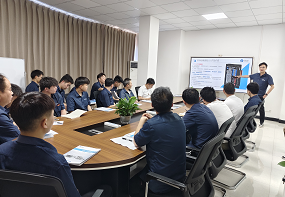
April 30, 2026 – To further improve the R&D precision and production conversion efficiency of complete automatic lines for SMD inductors, and to strengthen upstream technical collaboration, our R&D and Production departments recently co‑hosted a two‑day specialized training on “Stepper Motor Configuration, Sizing & Dynamic Calculation” with our core supplier, a strategic partner. As a professional provider of complete automatic solutions for SMD inductors, our products cover winding machines, dispensing machines, soldering machines, testing & packaging machines, assembly machines, serving a full range of inductors including T‑Core (large & small), common mode, NR, high‑frequency ceramic, molded, shielded, and CD types. This training aims to control the selection logic of motion control components from the source, laying a solid foundation for high‑precision, high‑stability inductor automation equipment.
As inductor manufacturing processes demand ever‑higher positioning accuracy, response speed, and energy efficiency, scientific stepper motor selection has become a critical factor affecting equipment performance and cost. In the past, many engineers relied on empirical estimation, leading to frequent step loss on winding machine spindles, offset of dispensing points, and unstable wire feeding on soldering machines. In this training, senior application engineers from the supplier systematically explained three core modules using numerous real‑world cases: torque‑frequency characteristic curve analysis (revealing non‑linear output torque at different speeds to avoid high‑speed step loss); inertia matching calculation (deriving the optimal ratio between load inertia and rotor inertia, typically recommended within 5~10 times); and acceleration/deceleration dynamic model (calculating the theoretical minimum acceleration/deceleration time and motor temperature rise boundaries based on S‑curves or trapezoidal curves).
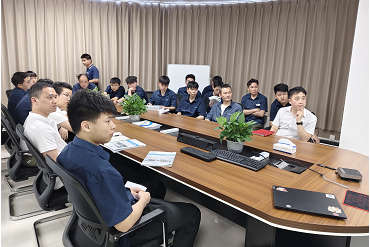
Based on our upcoming new high‑speed automatic winding machine for SMD inductors project, the R&D and production teams jointly simulated and verified multiple selection schemes on site. By incorporating actual parameters such as reciprocating load torque of the winding needle, rail friction coefficient, and safety factor, the team discovered that a previously estimated 57‑frame stepper motor had insufficient torque margin at high speeds. Replacing it with an 86‑frame series theoretically eliminates the risk of stalling. The same method was quickly transferred to the selection verification of the dispensing head rotation axis on dispensing machines and the wire feeding mechanism on soldering machines.
This training broke away from traditional one‑way lectures, adopting an interactive structure of “supplier theoretical breakdown + R&D/production hands‑on exercises + three‑party joint review.” On the manufacturing process side, both parties explored how motor mounting tolerances affect running noise and service life – uneven air gap in the stator/rotor induces electromagnetic vibration, while bearing coaxiality deviation accelerates wear. For common production line issues such as stalling and step loss on our winding machines and testing/packaging machines, the team established a systematic troubleshooting and calculation model, mapping failure phenomena to specific selection parameters (e.g., current setting, microstepping resolution, voltage margin).
The R&D Technical Director commented: “By directly linking the supplier’s underlying physical models with our actual load curves, selection has been upgraded from experience‑based to data‑driven. Previously it took 2–3 weeks to tune motor parameters on the prototype; now we can lock the optimal model at the design stage, hopefully shortening the debugging cycle by over 40%. This is crucial for us to simultaneously advance multiple customized inductor equipment projects, such as molded inductor assembly machines and common mode winding machines.”
Meanwhile, production equipment engineers shared practical advice on motor lead definitions, driver microstepping settings, and heat dissipation design. For example, when a winding machine spindle frequently starts and stops, a very high microstepping resolution is not always better – an excessively high resolution forces the pulse frequency too high, making it difficult for the controller to respond. The production team’s empirical value of “20,000 pulses per revolution” for NR inductor winding machines was verified theoretically and then incorporated into the new selection specification. Such frontline feedback enables manufacturability and maintainability considerations to be embedded earlier in the R&D design phase.
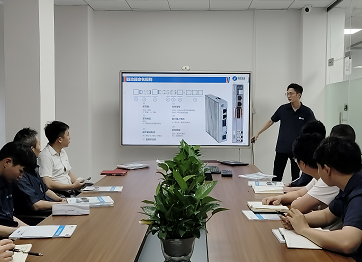
The supplier’s technical representative commented: “Your team’s rigorous questioning and systematic modeling capabilities are truly impressive. Especially because you cover complete equipment lines from winding, dispensing, soldering to testing/packaging and assembly, each process has different dynamic response requirements for stepper motors. This deep three‑party technical alignment will significantly shorten the distance from drawing board to stable mass production. We have already developed a quantifiable Stepper Motor Selection Calculation Worksheet.”
The company’s Deputy General Manager emphasized: “Although small, the stepper motor is the critical ‘peripheral nerve’ of all motion control equipment – winding machines, dispensing machines, soldering machines, etc. Simultaneously empowering R&D and production teams together with our supplier ensures a unified technical language, reduces sunk costs caused by selection errors, and accelerates the launch of high‑value‑added complete inductor automation lines. The selection worksheet produced from this training will be applied directly to all ongoing projects, including the next‑generation common mode inductor winding machine and molded inductor assembly machine.”
In the future, the company will normalize such “R&D – Production – Supplier” trinity technical alignment meetings, covering more core component areas such as servo motors, linear modules, and sensor systems, continuously building an agile and efficient collaborative R&D system. According to the roadmap, the next session will focus on “Servo System Inertia Identification and Self‑tuning Optimization,” for which preliminary cooperation intentions have already been reached with two international brand suppliers. Our company will continue to deepen our complete automatic solutions for SMD inductors, helping global inductor manufacturers improve capacity and quality with more stable and efficient equipment.